
Your baby was finally sleeping longer stretches.
Maybe even a 5 or 6 hour stretch. You started to feel human again.
And then, out of nowhere, they're waking every hour or two. Naps are 30 minutes. Nothing you did before seems to work.
If your baby is around 3 to 5 months old, there's a good chance you're in the 4 month sleep regression.
First, take a breath. You didn't cause this. Nothing is wrong with your baby. And this is not forever.
Here's what's actually happening.
What Is the 4 Month Sleep Regression?
The name is a little misleading. It's not really a regression. It's a progression.
Around 3 to 5 months, your baby's sleep permanently changes to look more like adult sleep. Newborns drop right into deep sleep and spend lots of time in light, active sleep. Around 4 months, your baby starts cycling through the stages of sleep the way you and I do.
That means every 45 minutes or so during naps, and every couple of hours at night, your baby comes into a lighter stage of sleep. Adults do this too. We just roll over and go back to sleep without remembering it.
Babies who don't yet know how to get back to sleep on their own wake up fully and call for help. Usually to recreate whatever helped them fall asleep in the first place, like feeding, rocking or bouncing. (If you want to go deeper on the "why," read what your baby's sleep regression means for their development.)
4 Month Sleep Regression Signs
Your baby might be in the 4 month sleep regression if you're seeing:
More frequent night wakings after a period of longer stretches
Short naps, often around 30 to 45 minutes
Fighting sleep or taking much longer to fall asleep
More fussiness and clinginess during the day
Increased hunger or more frequent feeding
Big developmental leaps like rolling, more babbling and more awareness of the world

How Long Does the 4 Month Sleep Regression Last?
For many babies, the hardest part lasts about 2 to 6 weeks.
But here's the honest truth. Because this is a permanent change in how your baby sleeps, the night wakings sometimes don't go away on their own if your baby still relies on help to fall asleep at every wake-up.
That's not a failure. It just means your baby is ready to learn a new skill, and you get to decide when and how you want to support that.
What Actually Helps During the 4 Month Sleep Regression
1. Watch Wake Windows
At 4 months, most babies do well with about 1.5 to 2 hours of awake time between naps. An overtired baby has a much harder time connecting sleep cycles. Here's my full guide to wake windows by age.
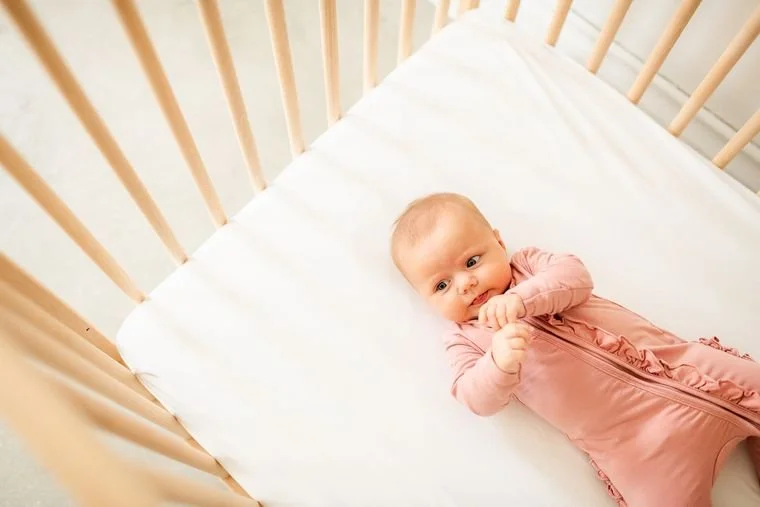
2. Make the Sleep Space Work for You
Dark room (darker than you think)
White noise played continuously through naps and nights
Room temperature between 68 and 72°F
Safe sleep always: baby on their back, in a crib or bassinet with a firm, flat mattress and nothing else in it
For more, here's how to create a safe and cozy sleep space for your baby.
3. Create a Short, Predictable Routine
A 5 to 10 minute nap routine and a 20 to 30 minute bedtime routine help your baby's brain know sleep is coming. Same steps, same order.
4. Practice Drowsy but Awake (When You're Ready)
Try putting your baby down sleepy but still a little awake for the first nap of the day or at bedtime. This is the time of day when sleep pressure is highest, so it's easiest. If they fuss, it's okay to pick them up, calm them and try again. Curious whether it really works? Read what drowsy but awake is and whether it works.
5. Feed Fully During the Day
Big developmental leaps can make babies distracted eaters. Offer full feeds in a calm, quiet space during the day so they aren't making up for it at night.
6. Take Care of You
This one matters just as much. Trade off night shifts with your partner if you can. Nap when someone else is on duty. Ask for help. You cannot pour from an empty cup.
When Is My Baby Ready for Gentle Sleep Support?
I don't recommend any formal sleep training before 16 weeks. After that, if the night wakings are wearing your family down, gentle sleep support can help your baby learn to fall asleep and resettle without cry-it-out.
It's a responsive, step-by-step process where you stay with your baby and support them as they learn. You don't have to choose between your baby's needs and your own rest. Here's more on sleep training without cry-it-out.
Your 4 Month Sleep Regression FAQs
When does the 4 month sleep regression start?
It usually starts between 3 and 5 months. Some babies show signs as early as 12 weeks, others closer to 5 months.
How do I know if it's the 4 month sleep regression or something else?
If your baby suddenly wakes more often, takes short naps and is around 3 to 5 months old, it's likely the regression. If your baby has a fever, seems in pain or isn't feeding well, check in with your pediatrician.
Should I feed my baby every time they wake during the regression?
Your baby may genuinely be hungrier during growth spurts, so feeding is okay. If they're feeding every hour and only taking a few sips before falling asleep, they may be waking to be soothed back to sleep rather than from hunger.
Can I prevent the 4 month sleep regression?
You can't prevent the brain development behind it, but healthy sleep foundations in the newborn months, like age-appropriate wake windows, a consistent routine and a good sleep space, can make it much easier.
Is it okay to rock or feed my baby to sleep during the regression?
Yes. You're not creating bad habits by comforting your baby. When you're ready for change, you can gently shift those habits at your own pace.
Does every baby go through the 4 month sleep regression?
The change in sleep cycles happens for every baby because it's a normal part of development. Not every baby has a hard time with it, though. Some barely skip a beat, while others need more support to connect sleep cycles.
Why are my 4 month old's naps only 30 minutes long?
A 30 to 45 minute nap is about one sleep cycle. When your baby comes into lighter sleep at the end of a cycle, they may wake fully. Short naps are common at this age and often lengthen with good wake windows, a dark room and practice falling asleep. Here are 10 ways to help short naps get longer.
You Are Not Doing It Wrong
The 4 month sleep regression is one of the hardest stretches of the first year.
If you're reading this at 3 AM with a baby on your chest, I want you to know something. This is not a sign that you've failed. It's a sign that your baby's brain is growing exactly the way it should.
It will get better. And if you want help getting there faster, I'm here.
4 Month Sleep Regression: Quick Recap
The 4 month sleep regression usually starts between 3 and 5 months.
It happens because baby sleep permanently shifts into adult-like sleep cycles.
Common signs include more night wakings, 30 to 45 minute naps and fighting sleep.
The hardest part often lasts 2 to 6 weeks.
Wake windows of about 1.5 to 2 hours, a dark room, white noise and a short routine help.
Gentle, no cry-it-out sleep support can start after 16 weeks if your family is ready.
Keep Reading
Your Ultimate Guide to Surviving the 4 Month Sleep Regression
Top 4 Sleep Challenges for the 4 Month Old and How to Approach Them
Newborn Wake Windows by Age: How Long Should Your Baby Be Awake?
Grab Your Free Newborn Sleep Guide
Wake windows, sample routines, sleepy cues, and the 6 sleep foundations I use with every family.
Get the free Newborn Sleep Guide here
Want a Plan Made Just for Your Family?
If you're tired of guessing, my 1:1 VIP Sleep Coaching gives you a personalized, gentle sleep plan and daily support from me until your nights feel calm again. No cry-it-out.
Book your VIP Sleep Coaching here
Want the Full Step-by-Step Plan?
My 4-Month Sleep Regression Course walks you through exactly what to do, gently and at your own pace, so you can stop guessing and start getting longer stretches of sleep again.
Get the 4-Month Sleep Regression Course here
Unnati Patel is a certified pediatric sleep consultant, published epidemiologist (MPH), and founder of Nested to Rested Sleep. She has helped thousands of families worldwide achieve better sleep using a gentle, evidence-based, family-centered approach, no cry-it-out required. She lives in Atlanta, GA with her husband (a child psychiatrist) and their two children.