
Newborn Sleep in the First 2 Months: What's Normal and Why Your Baby Won't Sleep
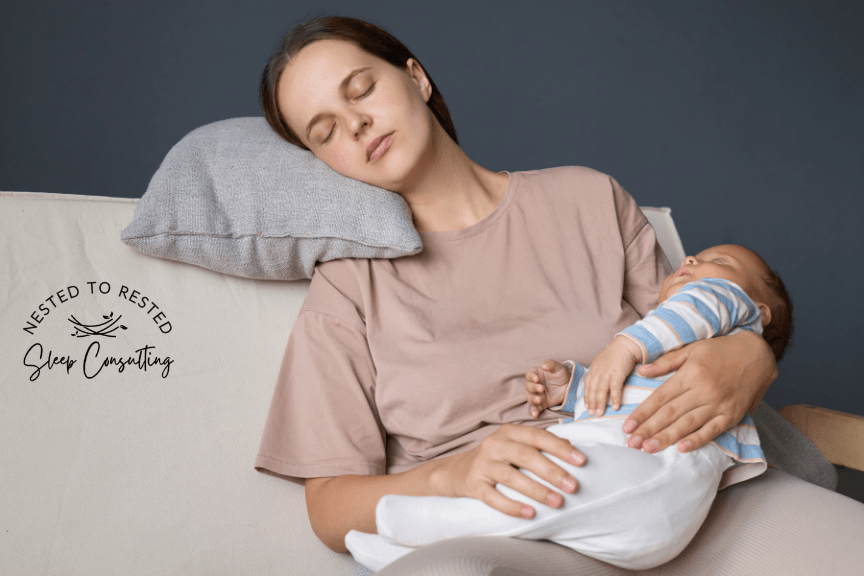
You just had a baby, and you're exhausted.
You're Googling things like "is it normal for my newborn to never sleep" and "why won't my baby sleep unless I'm holding them". Not to mention that you're doing it at 3 AM with one eye open.
And somewhere in between the cluster feeding and the witching hour meltdowns, a tiny voice in the back of your head is whispering: “Am I doing something wrong?”.
I am here to tell you, you're not.
Newborn sleep is genuinely, biologically hard. Not because you're failing but because your baby's sleep is designed to look nothing like yours. And once you understand what's actually happening in those first 8 weeks, something really powerful happens. You stop blaming yourself.
That matters more than you know.
This blog walks you through everything you need to know about your newborn’s sleep in the first 2 months: what's normal, what the science says, what your baby's sleep actually looks like week by week, and what gentle things you can start doing from day one to lay the foundation for better sleep ahead.
No cry-it-out. No rigid schedules. Just real, evidence-based support. The kind you deserve and crave as a parent.
Why Newborn Sleep Looks Nothing Like Adult Sleep
Here's what nobody tells you at the hospital…
Newborns spend about 50% of their sleep in active (REM) sleep, the light, easily-disrupted kind. For adults, it's closer to 20–25%.
That means the stirring, the twitching, the little grunts and whimpers, the eyes that flutter open and close and all of it is normal. It's not a malfunction. It's not something you caused. It's just where your newborn baby is developmentally.
Here's something else worth knowing: newborns don't have a circadian rhythm yet.
That internal clock that tells your body it's nighttime and time to sleep? Your baby’s isn't formed just yet. It typically starts to develop around 6–8 weeks and becomes more established closer to 3–4 months. That's why your baby can sleep a solid 3-hour stretch at 2 PM and then be wide awake and hungry at 2 AM.
It's not personal. It's just biology.
Their sleep cycles are also much shorter than yours, about 20–40 minutes compared to the 90-minute adult sleep cycle. This is why you'll put a sleeping baby down and have them wake up 25 minutes later looking bright-eyed and ready to party. Short naps in the newborn stage are completely, 100% normal.
Newborn Sleep Schedule: What to Expect in the First 8 Weeks
Let's break this down week by week so you know exactly what you're working with.
Weeks 1–4: Pure Survival Mode (And That's Okay)
In the first month, your baby needs 16-18 hours of sleep total in a 24-hour period — but it's broken into short chunks around the clock. There is no day. There is no night. There's just sleep, eat, tummy time, and repeat.
What's completely normal at 0–4 weeks:
Waking every 1.5–2 hours (this is biologically necessary, not a bad habit) during the day and about every 3-5 hours during the night to eat.
Short naps of 20–45 minutes
Fussiness in the evenings
Falling asleep during feeds
Day-night confusion. Sleeping more during the day, awake at night
Needing to be held to sleep
If your baby is doing all of these things, you don't have a sleep problem. You have a newborn.
Wake windows at this age: 30–45 minutes. That's it. Watch for sleepy cues: glassy eyes, a far-off stare, slight fussiness, and start your wind-down before those cues turn into an overtired meltdown.
Weeks 5–8: The First Signs of a Rhythm
Around the 4–6 week mark, something small but hopeful starts to happen.
Your baby's circadian rhythm begins to emerge. Some babies start showing slightly longer nighttime stretches, maybe 5-6 hours between feeds at night. You might start to notice a tiny pattern forming in the chaos.
What's normal at 4–8 weeks:
Longer alert periods during the day (they're more awake and interactive now)
Witching hour may still be intense
Naps are still short and unpredictable
Nighttime sleep may start to consolidate slightly
Wake windows at this age: 45–60 minutes.
This is also when you can start gently planting the seeds of healthy sleep habits.
How to Help Your Newborn Sleep Better (Without Sleep Training)
Sleep training is not appropriate for newborns. Your baby is not developmentally ready for it, and it's not something I recommend before 16 weeks. But that doesn't mean you're helpless. There are gentle foundations you can start from day one that make a real difference.
1. Set Up a Sleep-Friendly Environment
Your baby spent 9 months in a dark, warm, noisy womb. Recreate that.
Dark room: For both naps and nighttime sleep, a dark room is your best friend. During daytime naps, it should be dark enough that if you held your hand in front of your face, you couldn't see it.
White noise: A sound machine placed 4–5 feet from the sleep space at about 50 decibels helps drown out household noise and mimics the familiar sounds of the womb. (Download the free Decibel X app to check the level.)
Cool temperature: The ideal sleep temperature is 68–72°F. Babies sleep better when they're slightly cool.
Keep it boring: No mobiles spinning above the crib, no bright lights, no busy patterns. The crib should say sleep, not playtime.
2. Follow Awake Windows (Not the Clock)
One of the most powerful tools you have right now is awake windows. This is the amount of time your baby can comfortably stay awake before needing to sleep again. For newborns, awake windows start when thier eyes open and end when their eyes shut for sleep.
Newborns have tiny tanks. Push past the window and you'll end up with an overtired baby who is much harder to settle.
Awake windows by age:
0–4 weeks: 30–45 minutes
5–8 weeks: 45–60 minutes
9–12 weeks: 60–90 minutes
12–16 weeks: 1.5–2 hours
Start your wind-down a few minutes before the window ends or as soon as you see those first sleepy cues (glassy eyes, looking away, slight fussiness).
3. Establish a Simple Routine
Babies thrive on routine. Even in the newborn stage, a short, consistent sequence before sleep signals to their brain: sleep is coming.
For naps (5–10 minutes): Feed → quick cuddle → white noise on → into sleep space with a consistent phrase like "I love you, sleep well."
For bedtime (25–30 minutes): Feed → bath (not every night, but consistently when you do it) → massage → pajamas → books or singing → cuddles → into sleep space with a consistent phrase like "I love you, sleep well."
The routine doesn't have to be perfect. It just has to be consistent.
4. Expose Baby to Natural Light in the Morning
This is one of the simplest things you can do to help your baby's circadian rhythm develop. Morning sunlight boosts serotonin production, which later converts to melatonin (the sleep hormone) at night.
Open the curtains, take a walk outside, or sit in a sunny spot inside. Even 10–15 minutes makes a difference.
5. Keep Nights Dark and Boring
When your baby wakes for a nighttime feed, keep the lights low, your voice quiet, and the interaction minimal. No playing, no bright lights, no stimulating conversation.
The message you're sending: night is for sleeping, not for fun.
6. Learn the Pause
Here's something that can save you a lot of unnecessary wake-ups:
When your baby stirs, makes noise, or even opens their eyes, learn to wait before you go in.
Newborns spend so much time in active (REM) sleep that they often look awake when they're not. They wiggle, whimper, even cry out, and then surprisingly drift back to sleep on their own if given the chance.
Give it 1–2 minutes. Watch and wait. You might be surprised.
(If your baby is truly awake, they'll escalate — then you go in.)
Safe Sleep: What You Need to Know
Safe sleep is non-negotiable, and I want to make sure you have the full picture.
Always follow the ABCs of safe sleep:
A — Alone: Your baby sleeps alone in their sleep space. No stuffed animals, pillows, bumpers, or loose blankets.
B — Back: Always place baby on their back for every sleep.
C — Crib: A firm, flat surface in a bassinet, crib, or pack-n-play with a fitted sheet.
Keep the room temperature between 68–72°F and dress baby appropriately for the temperature. (A 1.0 TOG sleep sack is great for most room temperatures in this range.)
Baby should stay in your room (not your bed) for at least the first 6 months if possible.
When Should You Actually Be Concerned?
Newborn sleep is unpredictable, and most of what feels alarming is completely normal. But there are a few things worth watching for:
Baby is sleeping more than 20 hours (in a 24-hour period) and is difficult to wake for feeds
Baby is inconsolable for hours and cannot be settled
You notice breathing irregularities during sleep, like long pauses, labored breathing, or color changes
Baby is not gaining weight appropriately or eating enough (talk to your pediatrician)
If any of these apply, reach out to your pediatrician. Trust your gut, always!
FAQ: Your Most Googled Newborn Sleep Questions, Answered
Is it normal for a newborn to wake every 2 hours at night?
Yes, completely normal. Newborns have tiny stomachs and need to feed frequently, both for nutrition and to support their rapid brain development. Waking every 2–3 hours at night in the first 4–6 weeks is biologically expected and sometimes necessary.
Why won't my newborn sleep unless I'm holding them?
Because being held feels like the womb, warm, cozy, and safe. Contact napping is a completely valid way to get your baby to sleep in the early weeks. It won't create permanent “bad” habits. Your baby is not manipulating you, they just came from the most snuggly place on earth and your arms are the closest thing to it.
When do newborns start sleeping longer stretches?
Most babies begin consolidating sleep around 3–4 months as their circadian rhythm matures and their sleep cycles lengthen. With consistent sleep foundations in place from the newborn stage, many families start to see improvement before that. Every baby is different, and that's okay.
Should I wake my newborn to feed?
Yes, in the first 6–8 weeks, you should wake your baby if they've been sleeping longer than 2 hours during the day. You don't want to miss feeding windows, especially while your milk supply is being established. More feeding during the day = potentially less frequent wake-ups at night.
Is contact napping bad for my baby?
Nope, not at all. Contact napping is safe (as long as you're awake and alert), normal, and actually beneficial for bonding and regulating your baby's nervous system. If it's working for your family and keeping you sane, keep doing it.
What if my baby is only sleeping 20 minutes at a time?
Short naps (20–45 minutes) are developmentally normal in the newborn stage because of short sleep cycles. You can try to help extend them by making sure the environment is dark, and the sound machine is on, catching the sleep window before baby is overtired, and gently resettling at the 20-minute mark if possible. But honestly? Some short naps are just short naps. It won't be this way forever.
You're Doing Better Than You Think
Here's what I want you to hold onto after reading this:
The fact that you're here, reading this at whatever hour it is, trying to understand your baby and do right by them, that tells me everything I need to know about the kind of mom you are.
You're a great one.
The newborn stage is genuinely hard. It's not hard because you're doing it wrong. It's hard because it is hard. For every family. No matter what anyone else's Instagram looks like.
Rest when you can. Ask for help when you can. And know that these foundational habits you're building right now? They matter. They're working, even when it doesn't feel like it.
Want a Week-by-Week Newborn Sleep Guide?
I put together a free Newborn Sleep Guide that walks you through exactly what to expect in the first 3–4 months. It includes awake windows, sample routines, sleepy cues, and the 6 sleep foundations I use with every family I work with.
Grab your free Newborn Sleep Guide HERE
Ready for More Than a Guide?
If you're in the thick of the newborn stage and you want more than a PDF or if you want a community of moms who get it, live expert support, and a sleep plan that actually fits your family, come join us inside the Creating Well-Rested Families Membership.
It's the village parents need.
Enroll today for $1 your first month and become a well-rested family
Unnati Patel is a certified pediatric sleep consultant, published epidemiologist (MPH), and founder of Nested to Rested Sleep. She has helped thousands of families worldwide achieve better sleep using a gentle, evidence-based, family-centered approach — no cry-it-out required. She lives outside Atlanta, GA with her husband (a child psychiatrist) and their two children.